
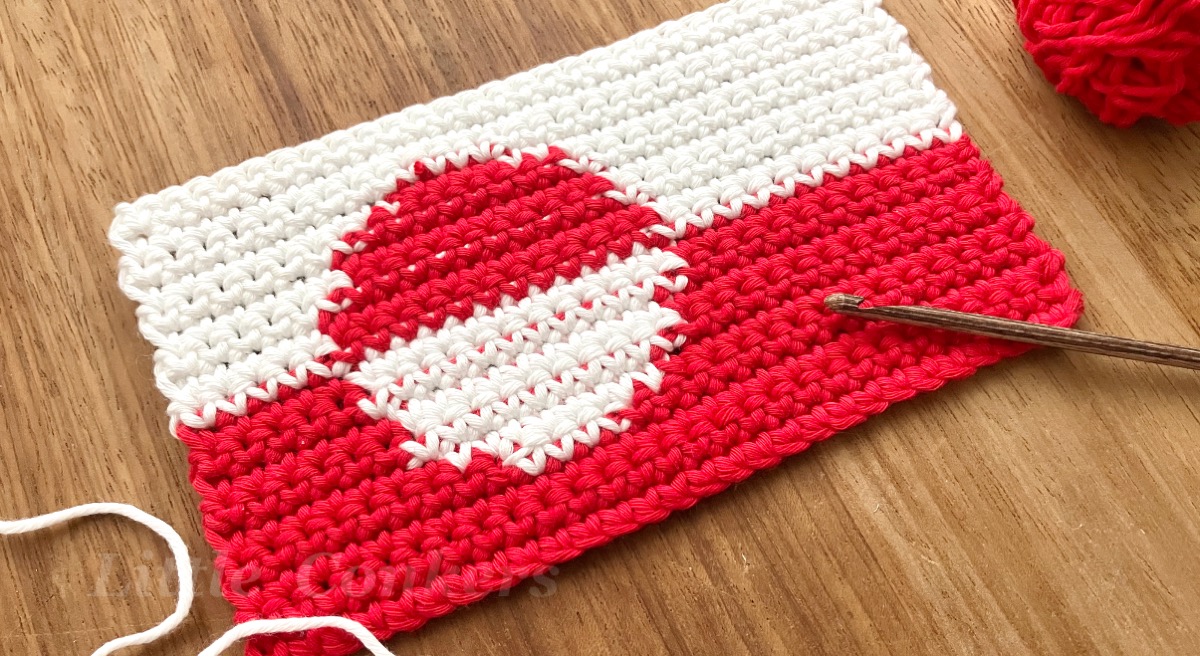
This certainly wasn’t on my planned list of patterns to publish this year, but late last night I felt a sudden urgent inspiration to create a crochet pattern for Greenland’s flag.
Once before events inspired me to publish a crochet pattern for the EU Flag.
Maybe it’s because I feel otherwise impotent in the face of bewildering geo-political lunacy, and maybe it’s pointless, but this is one small thing I can offer to the world.
Greenland Flag Crochet Pattern
Make the flag any size you like:
- In DK (light worsted-weight, Category 3 yarn) with 3.5mm hook, the finished flag is approximately 14cm x 9cm.
- In Aran (worsted-weight, Category 4 yarn) with a 4.5mm hook, the finished flag is approximately 16cm x 10.5cm.
The pattern is in UK terminology – if you prefer US terms, just replace ‘dc’ with ‘sc’ and work everything else the same.
The flag is worked back-and-forth starting at the bottom edge. It is intended to be double-sided, but if you know you are going to use it single-sided, you can be more relaxed about how you carry the non-working yarn and work in your tails.
Working with colour changes
Change colours by completing the last yarn-round-hook (US: yarn-over) of the previous stitch with the new colour.
Crochet is an imperfect medium for creating a crisp circle circumference at this scale, so your circle motif will inevitably be a bit ragged. The non-working colour will also tend to show through as you carry it across the circle motif (the red yarn through the white stitches and vice versa). Both these factors may be less obvious if you are using wool or acrylic yarn rather than the cotton I have used here, which gives very strong stitch definition.
You could avoid this by working with separate balls of the main colour yarn either side of the central motif. So in the first half you would work with one ball of red yarn until you changed to white, and then drop the red yarn, work in white without carrying the red, and then use a second ball of the red yarn when you change back to red. In my examples I have not done this, but simply carried the non-working yarn across each row.
In the bottom half of the flag, carry the white non-working yarn along a few stitches, nearer to where it will next be needed. For example in Row 4, after changing back to red, carry the white yarn along two stitches, then when you work back on Row 5, the white yarn will be available where it is needed.
Written Pattern
With red yarn, make 29ch.
Row 1 (right side): dc in second ch from hook and each ch to end (28dc).
Rows 2-3: 1ch, turn, dc in each dc across.
Row 4: 1ch, turn, 9dc in red, 4dc in white (carrying your red yarn along by encapsulating it in your white stitches), 15dc in red.

Row 5: 1ch, turn, 13dc in red, 8dc in white, 7dc in red.
Row 6: 1ch, turn, 6dc in red, 10dc in white, 12dc in red.
Row 7: 1ch, turn, 12dc in red, 10dc in white, 6dc in red.
Row 8: 1ch, turn, 5dc in red, 12dc in white, 11dc in red.
Row 9: 1ch, turn, 11dc in red, 12dc in white and cut the white yarn after changing to red in the last st, 5dc in red changing to white in last st.

Row 10: 1ch, turn, 5dc in white carrying the non-working red yarn along until needed, 12dc in red, 11dc in white.
Row 11: 1ch, turn, 11dc in white, 12dc in red, 5dc in white.
Row 12: 1ch, turn, 6dc in white, 10dc in red, 12dc in white.
Row 13: 1ch, turn, 12dc in white, 10dc in red, 6dc in white.
Row 14: 1ch, turn, 7dc in white, 8dc in red, 13dc in white.
Row 15: 1ch, turn, 15dc in white, 4dc in red, 9dc in white.
Rows 16-18: 1ch, turn, dc in each dc across.
Cut yarn and fasten off.
Pattern diagram


Weave in your yarn tails as neatly as possible. You can use them to help emphasise the circular shape a little.


I have based my flag on the principals used by Solmuteoriaa in his wonderful series of crochet patterns for all the flags of the European Union. Please do take a look at his pages.

I can’t express how perfect I think his idea to create these patterns are. It appeals immensely to my sense of order and accuracy that he has been to the trouble of making each flag in its correct proportions too.
I have used the same basis as Solmuteoriaa patterns, so that if you make any of his other flags, this flag will be to the same scale. The Greenland flag, which I have read is referred to as Erfalasorput in the Greenlandic language, has a proportion of 2:3.
If you’re looking for a more complete Greenland Flag pattern, do check out this pattern by Maria Jęczmyk. I believe in designers being paid for their work, which is why I don’t usually publish free patterns. But in this instance I felt it was in keeping Solmuteoriaa’s original project to do so, and this pattern is not written in my usual fully detailed style with step-by-step photos.

I feel the need to apologise for this futile offering that doesn’t really help anything or anyone. But maybe it’s a little refuge for someone for a few minutes, and a way to feel connected to other crafters around the world. Do share your thoughts and how you have used this pattern.