
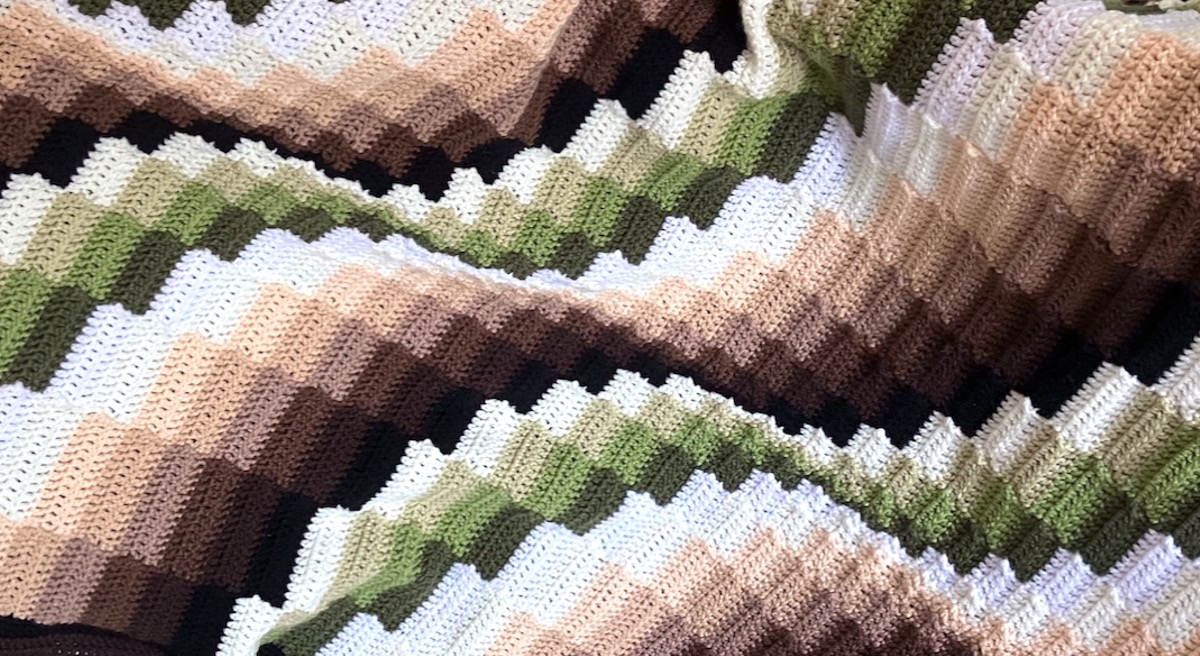
This is a crochet bargello blanket I made as a Christmas gift for my son who is always complaining of the cold in his digs at university.
Apart from the huge howling error (of which more below) I’m actually pretty pleased with it. The bargello pattern is a fun, striking design that was reasonably quick to crochet, and I’ve used an acrylic that feels robust and should make the blanket easy for my son to take care of.

The last blanket I made for my eldest was a lot more work and a lot less practical – it has not gone to university with him…
The bargello blanket pattern
The pattern I used is the Bargello Blocks Throw by Michelle Westlund which you can find on Ravelry. It’s an unusual style of pattern because the bulk of it is related to the mechanics of setting up the wave pattern, rather than it being a row-by-row pattern of the crochet stitches that you work to create the blanket. It’s very much a ‘teach a man to fish’ sort of a pattern because once it clicks, you hardly need to look at the pattern for the rest of the blanket. The only bit that takes some focus at first is joining each block of colour to the next block of colour in one horizontal row, but this is covered in detailed videos, to which links are provided in the pattern.
I made a smaller version than the original – a largish lap blanket, and it took me a couple of month in the run up to Christmas.
If I had it to do over again, and if I was making another smaller blanket like this one, I’d start at a different point in the wave pattern. This would allow the waves to appear in a more balanced way across the width of the blanket (as they do for the original design for a larger blanket). The excellent way Michelle sets up the foundation row, means that you can just keep adding width until it is the size you would like. Since I winged it and was trying not to stress too much about it as an every-day blanket, I just followed the layout given in the pattern.
Yarn choices for my bargello blanket
Since this was a personal project and needed to be affordable and practical for my son to wash in the communal machines at university (!), I used acrylic yarn for this blanket. The critical part of this whole design is the choice of colours, so you really just have to go with a yarn that has a very large range of colours available. In a blanket like this, mixing different yarns is a risk, as the slightest difference in tension or texture will really show up. The key to success is, I think, keeping everything but the colours exactly the same, so achieve the desired dramatic optical effect.
I used Sylecraft Special DK and a 4mm hook. This is not my favourite yarn, but it’s reasonably affordable and available in a large range of colours. As it is a very widely-used yarn, you can find enough pictures online to give you confidence choosing your colours. Since I don’t have a physical yarn shop to visit, I spent a lot of time looking at projects people have posted online using this yarn, to see the colours in different lights and next to different other colours, until I could decide on my colours for this blanket. Here’s what I used for my bargello blanket:

I originally planned to use 1020 Lemon as the lightest colour in the green fade, which appears online as a very pale, cool yellow. However, when it arrived I decided it was too bright alongside the rest of the colours, so I used 1005 Cream again instead.
I would have loved to use the heathered colours 1126 Sandstone and 1124 Greengage, which I think would sit beautifully between some of the other shades used. But in the end I decided again that sticking to plain, solid colours would make sure the overall bargello design does all the talking with no distractions.
The overall effect of the blanket, if you step back and look at it, is rather lighter in tone than I might ideally have chosen. (The howling error has also perhaps exacerbated this.) In other words, I think doing it again I wouldn’t start the fades with such light colours. But again, it would be difficult to find a yarn with sufficient colours available to make an effective fade without using this full range of tones.
Blanket border
For the border I just made that up myself using plain rows of dc (US: sc) and tr (US: dc). You definitely don’t want any kind of fussy border with this pattern. Picking your darkest colours is the safest way to go.
The horrendous error
Now on to the huge mistake that some of you will have spotted…

The issue is that on two of the brown fades, I managed to miss out the darkest brown, so used only seven colours rather than the eight there should have been. I put this down to rushing and working in the dark late at night, when the colours were indistinguishable. I noticed the error and didn’t repeat it, but decided I’d rather get the blanket finished for Christmas than go back. In the end, I think it’s okay, certainly for the purpose.
Leftover yarn
As a result of using it in both fades, the 1005 Cream is the only colour of which I used a whole ball. I would have used less if I hadn’t made the aforementioned howler! I have around half a ball left of all the other colours except 1002 Black which I used for the border.
I used some of the leftovers to make a couple of the quick crocheted fingerless gloves I’ve made before, to go with the blanket, to help keep my chilly son warm.

You can see full details of the pattern for these gloves and examples made by others via my Green and Brown Fingerless Gloves Ravelry project.
The rest of the leftovers – because by definition they make a coherent set of colours – are already inspiring me with new throw blanket ideas, which I will be sure to share as I develop them.